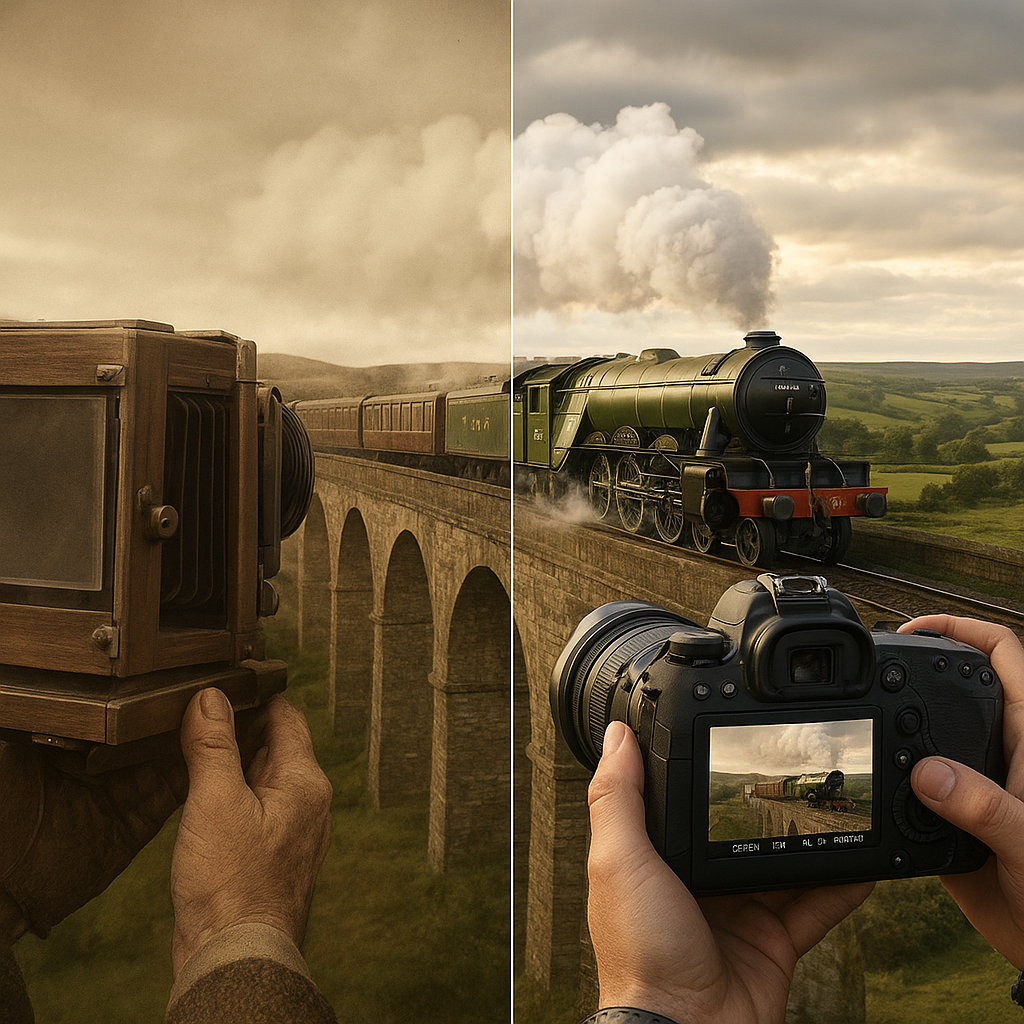
Railway photography has been part of British visual culture for well over 150 years. From the earliest daguerreotypes of steam locomotives to the high-resolution digital images uploaded to Flickr groups today, the way enthusiasts, artists, and historians have captured the railway has evolved in step with the trains themselves. Understanding this evolution matters more than ever, because the photographs taken today will become tomorrow’s historical record — just as the work of Victorian pioneers now fills the archives of the National Railway Museum.
This article traces the full arc of British railway photography: the pioneering years of the nineteenth century, the golden age of steam, the upheaval of the British Railways era, and the digital revolution that has transformed both how images are made and how they are shared.
The Earliest British Railway Photographs
The railway arrived in Britain before photography did. The Liverpool and Manchester Railway opened in 1830, and it was another nine years before Louis Daguerre made his photographic process publicly available in 1839. That means the very earliest railways were documented entirely by painters, draughtsmen, and printmakers — and only later captured on glass plates.
So what are the earliest British railway photographs ever taken? The answer is not a single famous image but a scattered collection of daguerreotypes and early calotypes from the 1840s. One of the most significant figures from this period was the Scottish engineer and photographer Robert Howlett, whose 1857 portrait of Isambard Kingdom Brunel standing before the launching chains of the SS Great Eastern remains one of the most iconic photographs of the railway age — even though it depicts a ship rather than a train. Howlett also photographed the construction of the Great Eastern, and his work demonstrated that industrial subjects could carry genuine artistic weight.
By the 1850s and 1860s, photographers were documenting railway construction across Britain. The building of the London and Birmingham Railway, the various mainline extensions, and the great railway bridges of the Victorian era all attracted photographers who recognised that these engineering feats were worth recording. The National Railway Museum in York holds extensive collections from this era, including albumen prints and collodion negatives that show not just locomotives but the labourers, navvies, and engineers who built the network.
The Technical Challenges of Early Railway Photography
Early railway photographers faced obstacles that modern enthusiasts can barely imagine. Glass plate negatives required a portable darkroom — essentially a tent or wagon — to be set up wherever the photographer was working. Exposure times of several minutes meant that moving trains could not be photographed sharply, so most early images are of stationary locomotives posed in sidings or at platform ends. The equipment was heavy, the chemistry was hazardous, and the results were unpredictable.
Despite all this, the body of surviving work from the 1840s through to the 1880s is remarkable. These images record not just the machines but the entire visual culture of the early railway: the architecture of stations, the uniforms of staff, the advertising posters on hoardings, and the landscapes the railway was transforming. Many of these early railway advertising posters have since become iconic collector’s items, valued as much for their artistic merit as for their historical significance.
The Golden Age of Steam Photography
If the nineteenth century established the craft, the early-to-mid twentieth century was when British railway photography truly came into its own. The period from roughly 1900 to 1968 — the year steam was eliminated from the mainline network — produced an extraordinary volume of work, driven by improvements in camera technology, the growth of railway enthusiasm as a hobby, and the sheer visual drama of steam traction.
The development of the roll film camera in the early twentieth century was a watershed moment. Cameras like the Kodak Brownie, introduced in 1900, made photography accessible to ordinary people for the first time. Railway enthusiasts — often young men with modest incomes but unlimited passion — began photographing trains in far greater numbers. The results were not always technically perfect, but they created an unprecedented visual record of the steam era.
The Great Railway Photographers of the Steam Era
Several photographers from this period produced work that transcended mere documentation and achieved genuine artistic distinction. Eric Treacy, who later became Bishop of Wakefield, is perhaps the most celebrated British railway photographer of the twentieth century. His black-and-white images of steam locomotives in the Pennines, often taken in dramatic weather conditions, are regarded as fine art as much as railway history. Treacy understood that a great railway photograph required patience, compositional skill, and an instinct for atmosphere — not just a fast lens and a convenient location.
Other significant figures include O. Winston Link in the United States, whose night-time photographs of the Norfolk and Western Railway influenced British practitioners, and the many anonymous photographers whose work now fills the archives of the National Railway Museum and the Railway Magazine. The Railway Magazine itself, first published in 1897, became an important platform for railway photography, and its archives offer a remarkable window into how the hobby developed over more than a century.
What Made Steam So Photogenic
Part of the reason the steam era produced such compelling photography is that steam locomotives are inherently dramatic subjects. They emit smoke and steam, they are large and mechanically complex, and they operate in landscapes — cuttings, viaducts, tunnels, and open moorland — that provide natural framing and atmosphere. The human element is also essential: drivers leaning from cab windows, firemen shovelling coal, and passengers on platform ends all add narrative to what might otherwise be purely technical images.
The end of mainline steam in August 1968 — marked by the famous Fifteen Guinea Special, the last steam-hauled passenger service on British Railways — was a cultural moment as much as a transport one. Thousands of enthusiasts turned out to photograph the event, and the images from that day are among the most widely reproduced in British railway history.
The British Railways Era: 1948 to 1994
The nationalisation of Britain’s railways in 1948 created British Railways, later rebranded as British Rail, and ushered in a period that many railway photographers initially viewed with ambivalence. The romanticism of the pre-grouping companies — the Great Western, the LMS, the LNER, and the Southern — had deep roots in enthusiast culture, and the standardised locomotive designs and corporate identity of the new nationalised network seemed, to some, less visually interesting.
In practice, the British Railways era produced some of the most compelling railway photography ever made in Britain. The transition from steam to diesel and electric traction created visual contrasts that were rich in narrative and atmosphere. Photographers documented the last years of steam with urgency, knowing that what they were recording would soon disappear. They then turned their attention to the new order: the English Electric Type 4s, the Brush Type 4s, the Deltics, and eventually the High Speed Train, which entered service in 1976 and remains one of the most successful British train designs ever built.
The British Railways Logo and Visual Identity
The visual identity of British Railways evolved considerably during its 46-year existence, and photographing this evolution became a subject in itself. The original 1948 crest, featuring a lion holding a wheel, was replaced in 1956 by the more modern “cycling lion” emblem, and then in 1965 by the now-famous double arrow symbol designed by Gerry Barney of the Design Research Unit. The double arrow was intended to convey the idea of a two-way railway, and it has become one of the most enduring pieces of British graphic design — so much so that it has survived privatisation and is still used today by National Rail.
Photographers documented each iteration of this identity as it appeared on locomotives, coaches, stations, and rolling stock. The result is a visual archive that tells the story not just of trains but of corporate Britain, design history, and changing public attitudes to nationalised industry.
Colour Film and the Changing Aesthetic
The widespread adoption of colour transparency film in the 1960s and 1970s changed the aesthetic of British railway photography fundamentally. Kodachrome, in particular, produced images with a distinctive colour palette — rich reds, deep blues, and warm greens — that now evokes the period as powerfully as any written history. Photographers who worked extensively in colour during the diesel and early electric era created a record that feels immediate and vivid in a way that black-and-white images, for all their artistic merit, sometimes do not.
The quality of colour film also improved steadily. By the 1980s, photographers working with Fujichrome and later Ektachrome could produce images of remarkable sharpness and colour fidelity. The British railway scene of the 1980s — with its sectorisation liveries, the arrival of the Class 43 HST sets in InterCity 125 branding, and the electrification of the East Coast Main Line — was documented in colour by a generation of photographers whose work is now studied as both history and art.
The Digital Revolution in Railway Photography
The arrival of digital photography in the late 1990s and early 2000s transformed British railway photography as profoundly as any previous technological change. The immediate benefits were obvious: no film costs, instant review of images, and the ability to shoot in low light at high ISO settings that would have been unthinkable with film. But the deeper changes were cultural and social.
How the Internet Changed Everything
Before the internet, railway photographers shared their work through railway societies, magazines, and exhibitions. The audience for any individual photograph was relatively small. The rise of photo-sharing platforms — Flickr, which launched in 2004, being the most significant for the railway photography community — changed this completely. Suddenly, a photograph taken at a quiet Midland station could be seen by thousands of people around the world within hours of being taken.
Online communities dedicated to British railway photography grew rapidly. Groups focused on specific regions, specific locomotive classes, specific eras, and specific photographic techniques. The collective knowledge accumulated in these communities — about locations, lighting conditions, historical liveries, and operational details — became an extraordinary resource for both photographers and historians.
YouTube added another dimension. Video footage of British railways, from heritage lines to the contemporary mainline, now reaches audiences in the millions. Channels dedicated to railway history and photography have introduced the subject to people who might never have encountered it through traditional print media.
The Technical Capabilities of Modern Equipment
Modern digital cameras offer capabilities that would have seemed extraordinary to earlier generations of railway photographers. High-speed continuous shooting — some mirrorless cameras can capture 30 or more frames per second — means that the precise moment of a locomotive passing a specific point can be captured with certainty rather than luck. High-resolution sensors allow images to be cropped significantly without losing quality. In-body image stabilisation makes handheld photography viable in conditions that would previously have required a tripod.
Drone photography has opened up entirely new perspectives on the British railway. Aerial views of viaducts, junctions, and stations that were previously impossible without access to aircraft are now achievable by any competent drone operator. The results have added a genuinely new visual dimension to the documentation of the railway network.
Preservation and Heritage Photography
The heritage railway movement, which began in earnest in the 1950s with the rescue of the Talyllyn Railway in Wales, has created a parallel universe of photographic opportunity. Britain now has more than 100 heritage railways and tramways, operating steam and diesel locomotives across routes ranging from a few hundred yards to more than 20 miles. Photographers can capture working steam in landscape settings that closely replicate the conditions of the pre-1968 era — something that was simply impossible during the diesel-only years of the 1970s and 1980s.
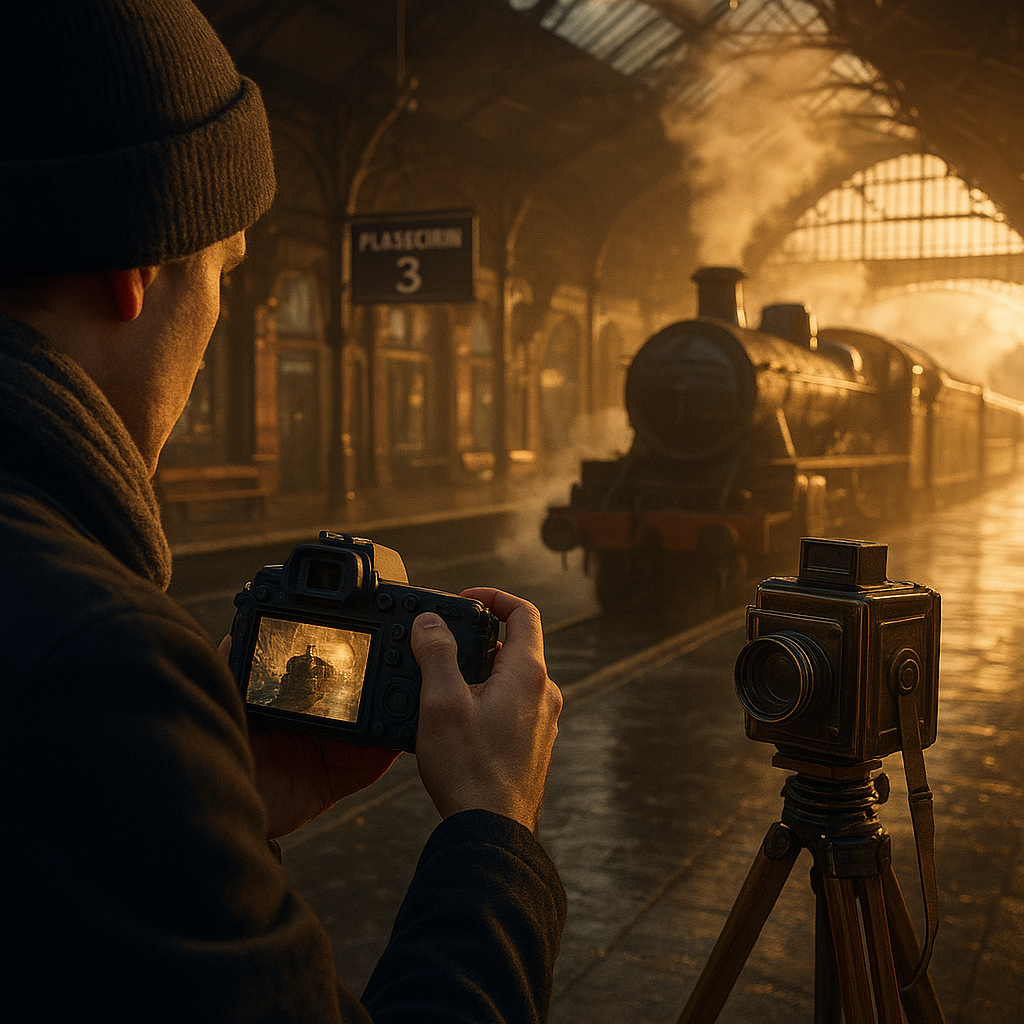
Heritage photography raises interesting questions about authenticity. A photograph of a steam locomotive on the North Yorkshire Moors Railway is genuinely beautiful, but it is a photograph of a preservation operation, not a working railway. Some photographers embrace this; others prefer to focus exclusively on the contemporary mainline network, documenting the railway as it actually functions today.
Practical Advice for Railway Photographers
Whether you are photographing a heritage steam gala or the contemporary mainline, certain principles apply consistently.
- Understand your subject. The best railway photographs are made by people who understand how the railway works — timetables, locomotive diagrams, infrastructure, and operating practices. Knowledge of the subject allows you to anticipate moments rather than simply react to them.
- Light is everything. The direction and quality of light can transform an ordinary location into an extraordinary one. Early morning and late afternoon light is generally more flattering than midday sun. Overcast conditions can work well for black-and-white photography and for emphasising industrial atmosphere.
- Composition matters as much as the train. A technically perfect photograph of a locomotive in a featureless location is less interesting than a well-composed image that places the railway within its landscape or urban context. Look for leading lines, natural frames, and human elements that add narrative. Getting the composition and settings right makes the difference between a snapshot and a photograph with genuine impact.
- Respect the railway and its rules. Photography from public land and stations is generally acceptable. Trespassing on railway property is illegal and dangerous. Always check the rules of individual heritage railways, as policies vary.
- Shoot in RAW format. RAW files retain far more information than JPEGs and allow much greater flexibility in post-processing, particularly when recovering shadow detail or adjusting white balance.
The Archive and Why It Matters
The National Railway Museum in York holds one of the largest collections of railway photographs in the world — more than one million images spanning the entire history of the railway in Britain. Its archive is an essential resource for researchers, historians, artists, and anyone interested in how the railway has shaped British life. The museum’s online collections allow public access to a significant proportion of this material, and its curators continue to acquire contemporary work, recognising that today’s photographs are tomorrow’s history.
Beyond the national collection, countless smaller archives exist in railway societies, local history groups, and private collections. The work of preserving and cataloguing these archives is ongoing and important. Photographs that seem unremarkable today — a Class 37 at a provincial station, a Pacer unit on a branch line — will acquire historical significance as the railway continues to change.
Frequently Asked Questions
When was the first British railway photograph taken?
There is no single definitive answer, but photographs of British railway subjects exist from the early 1840s, within a few years of the announcement of the daguerreotype process in 1839. The National Railway Museum holds examples from this period, and railway construction photography was well established by the 1850s.
Who is the most famous British railway photographer?
Eric Treacy is probably the most widely recognised name in British railway photography. His black-and-white images of steam locomotives in northern England, made primarily in the 1940s and 1950s, are considered among the finest examples of the genre. Many other photographers, including Ivo Peters, Colin Garratt, and Brian Morrison, have also made major contributions.
What camera settings work best for railway photography?
For moving trains, a shutter speed of at least 1/500th of a second is generally needed to freeze motion effectively. Aperture depends on the depth of field required — f/8 is a good starting point for most situations. ISO should be as low as lighting conditions allow. For static subjects such as locomotives at rest, a tripod and a small aperture will maximise sharpness and depth of field.
Can I photograph trains at British railway stations?
Photography for personal, non-commercial purposes is generally permitted on National Rail stations in Britain, provided you do not use a tripod, do not obstruct passengers or staff, and comply with any instructions from railway personnel. Commercial photography typically requires advance permission from the relevant train operating company or Network Rail.
What happened to railway photography after the end of steam in 1968?
Railway photography did not decline after 1968 — it adapted. Photographers turned their attention to diesel and electric traction, documented the changing infrastructure and liveries of the British Rail era, and later embraced the heritage railway movement as a way of continuing to photograph steam. The hobby has remained continuously active and has grown significantly in the digital era.
Conclusion
The evolution of British railway photography mirrors the evolution of the railway itself. Both have been shaped by technology, economics, culture, and the passion of the people who engaged with them. From the fragile daguerreotypes of the 1840s to the high-resolution digital files of today, each era has produced work that is both historically valuable and aesthetically compelling.
What connects the earliest pioneers to contemporary practitioners is a shared recognition that the railway is worth photographing — not just as a machine or a system, but as a subject that carries meaning about landscape, labour, progress, and national identity. The photographs being taken today, whether at a heritage steam gala or a modern electrified mainline, are the historical record of the future. That is a responsibility worth taking seriously, and a tradition worth continuing.